



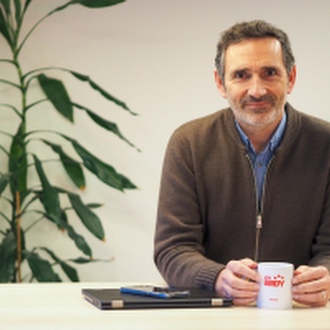
A coffee with José Ramón Barca, Supply Chain Director at Alcampo
L&A: José Ramón, you lead one of the most demanding supply chains in the food retail sector in Spain. How would you describe your day-to-day work at the helm of Alcampo’s supply chain?
José Ramón: I prefer to start by talking about the day-to-day work of the entire Supply team. At Alcampo, we work and collaborate continuously across departments. Our daily work is a constant balancing act between strategy and operations. Managing this type of supply chain with the capillarity of hypermarkets and supermarkets means dealing with a large volume of items, short expiration dates, and the pressing need for freshness and availability. From the first coffee, we analyze sales data, adjust demand forecasts, optimize transport routes, and ensure that each store receives exactly what it needs, at the right time. There is a large part of team management, cross-functional collaboration with departments such as Purchasing, Sales, and Store Operations, and resolution of unforeseen events. And all this in a high-pressure environment where agility and the ability to anticipate are key to ensuring that our customers find everything they are looking for on our store shelves.
L&A: Retail is undergoing a profound transformation driven by omnichannel, digitization, and automation. From your perspective, what trends will shape the consumer goods supply chain in the coming years?
José Ramón: In the coming years, we will see a deeper consolidation of omnichannel retailing: unified inventories and the ability to serve customers from any point (store, warehouse, dark store) in a fluid and efficient manner. Digitization will be the main driver; AI-based predictive analytics for demand and stock optimization will be the norm, not an advantage. At Alcampo, we will see an exponential increase in end-to-end visibility of the chain, using technologies such as blockchain for traceability and transparency. Automation will not be limited to large logistics centers; it will advance toward in-store order preparation for online sales and more efficient last-mile solutions, including autonomous vehicles and the intensive use of smart lockers. Finally, sustainability will be fully integrated, not only as an ethical goal, but as a pillar of efficiency and differentiation, with supply chains designed to minimize environmental impact and maximize the circular economy.
L&A: The balance between operational efficiency, sustainability, and customer experience is becoming increasingly complex. What improvements are you promoting to move toward more responsible and, at the same time, more competitive logistics?
José Ramón: For us, these three “strategic” pillars are not mutually exclusive, but interdependent. As I pointed out at the beginning of the interview, at Alcampo we interact constantly between all departments so that the decisions we make are aligned with the company’s strategies while taking into account the objectives of each department. In terms of operational efficiency, we are investing in advanced warehouse management systems (WMS) and transport management systems (TMS), along with the robotization of repetitive processes, to optimize movements and reduce costs.
In terms of sustainability, we are promoting the electrification of our delivery fleet and working to optimize loads and routes to minimize emissions. We are also pioneers in reducing food waste by improving demand forecasting and donations, among other solutions, and we are working to incorporate reusable packaging with a firm commitment to recycling materials. For the customer experience, these improvements translate into fresher products, faster and more reliable deliveries (both in-store and home delivery), and greater availability. For Alcampo, the goal is for a greener supply chain to also be a more agile chain that generates value for both the planet and the consumer.
L&A: Trade shows such as Logistics & Automation have become key spaces for connecting with new technologies, suppliers, and trends. How valuable are they for a company like Alcampo on its path toward more modern and flexible logistics?
José Ramón: In a sector as dynamic as ours, it is essential to stay abreast of the latest innovations and best practices in the market. These events offer us an unparalleled platform to: first, explore emerging technologies, from advanced robotics and AI solutions to optimization software, that could transform our operations. Second, connect with an ecosystem of suppliers and startups that are developing disruptive solutions. It’s not just about finding a supplier, but about establishing strategic alliances. And third, they allow us to observe market trends, understand how other industries are addressing similar challenges, and what new regulations or expectations are emerging. They are a catalyst for innovation, helping us refine our technology roadmap and ensure that our logistics remain at the forefront, adapting quickly to market demands.
L&A: And to wrap up this coffee chat… with your background in the retail sector, what inspires you about the future of the supply chain, and what changes would you like to see consolidated in the coming years so that retail remains accessible, efficient, and capable of responding to constantly evolving consumers?
José Ramón: What inspires me most, and what we are working on at Alcampo, is an increasingly intelligent and autonomous supply chain, driven by artificial intelligence and machine learning, capable of anticipating problems and adapting in real time. I imagine an ecosystem where demand forecasting continues to improve, inventories are managed dynamically, and the last mile responds to the real needs of our stores and customers. The change I would like to see consolidated is total integration and greater transparency throughout the entire chain, from the origin of the raw material to the final delivery to the customer. This would involve unprecedented collaboration between all players, sharing data to optimize resources, minimize environmental impact, and ensure quality and traceability. I would like to see a retail sector that, despite all this technology, remains accessible and capable of understanding and satisfying the individual needs of consumers, offering a shopping experience that combines digital efficiency, the warmth of human interaction, and social and environmental responsibility.


Subscribe our newsletter
MELYT and CONFEBUS join forces to promote female talent in bus transport
· Coinciding with the celebration of 8 March, International Women’s Day. · CONFEBUS is committed to bringing more women into the sector and addressing the
The importance of change management in technological transformations
When walking through the halls of an event as vibrant as Logistics & Automation, it is easy to be seduced by the industry’s ever-increasing brilliance.
Interview with Carlos Moreno: Leading Transport Transformation with SAP Transportation Management
1. Carlos, could you briefly tell us what your role is at Westernacher and how you support your clients in optimising their logistics processes? As
The industry does not have a production problem, it has a synchronisation problem.
Gabriel OcioCommercial Director, Supply Chain SolutionsZucchetti Spain For years, the focus of the industry has been on improving production capacity: more automation, more information and
Share this article