



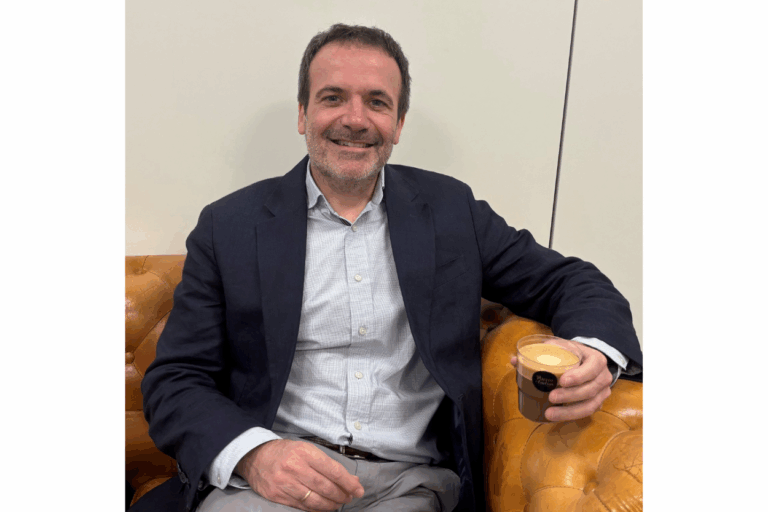
A Coffee with Eduardo Cornago Égido, Operations Director at Gin Puerto de Indias
L&A: Eduardo, you have built your career leading operations and supply chains in highly dynamic sectors such as food and beverages. What key lessons have accompanied you on your journey to becoming Operations Director at Puerto de Indias?
Eduardo: Throughout my career I have had the opportunity to work in very demanding sectors, with high turnover, strong cost pressure and a great sensitivity to service levels. If I had to summarise the key lessons, I would highlight three.
The first is that operations only work well when they are aligned with the business. It is not about optimising for the sake of optimising, but about understanding what the market needs and building processes that can support it reliably.
The second lesson is the importance of people. You may have very sophisticated technology, procedures and KPIs, but without committed teams with sound judgement, the supply chain suffers. Operations are largely about daily execution and constant decision-making, and for that the team is the key factor.
The third is accepting that continuous improvement is not a project; it is a way of working. Dynamic environments force you to question processes, learn from mistakes and adapt quickly. That mindset has accompanied me to Puerto de Indias and is what I try to instil today across the entire Operations area.
L&A: Puerto de Indias has experienced extraordinary growth, becoming one of the leading brands in the spirits sector. From an operational perspective, how do you manage such rapid evolution without losing efficiency, quality or responsiveness?
Eduardo: From an operational standpoint, such rapid growth is only sustainable if it is managed with anticipation, method and the right partners. At Puerto de Indias we have been clear from the outset that growth could not come at the expense of losing control, quality or service.
The key has been scaling processes rather than improvising solutions. That means professionalising planning, strengthening demand management and providing the operation with structures capable of absorbing peaks in activity without putting the system under strain.
It has also been essential to invest in visibility and coordination between departments. Operations cannot work in isolation from Sales, Marketing or Finance. Shared decision-making based on data has been crucial to maintaining efficiency.
Finally, we have focused heavily on industrial and logistics robustness: adequate capacity, operational flexibility and reliable partners. The goal is not simply to produce more, but to respond better. Growing quickly is a challenge; growing well is a responsibility.
L&A: The spirits sector requires precision, traceability and excellence in production. What role do digitalisation, automation and continuous improvement play today in the company’s operational strategy?
Eduardo: In a sector such as spirits, digitalisation and automation are not optional; they are key tools for ensuring control and reliability. At Puerto de Indias we see them as enablers of operations, not as an end in themselves.
Digitalisation allows us to anticipate: improving demand forecasting, planning with greater accuracy and reducing uncertainty in decision-making. This translates into fewer stockouts, fewer urgent situations and more efficient use of resources.
Automation, particularly in the logistics and industrial environment, helps us gain consistency, improve efficiency and productivity, reduce errors and enhance traceability — something critical in our sector.
All of this is supported by a very clear culture of continuous improvement. Analysing data, reviewing processes and correcting deviations are part of the daily routine. Technology accelerates that journey, but the real value lies in how you integrate it into the way teams work.
L&A: Trade fairs such as Logistics & Automation are key meeting points for discovering solutions and trends in the supply chain. What value do you think these events bring to Puerto de Indias, particularly in areas such as packaging, intralogistics or operational efficiency?
Eduardo: For Puerto de Indias, trade fairs such as Logistics & Automation are very valuable because they allow us to step away from day-to-day operations and gain perspective. In operations it is easy to become absorbed by urgency, and these events help you lift your head and look beyond the immediate.
They provide inspiration, but above all direct contact with real solutions: new intralogistics technologies, advances in automation, and more efficient or sustainable packaging proposals. Seeing them applied in practice, speaking with suppliers and exchanging experiences significantly accelerates learning.
Over the past five years we have not missed the event, and each year we have incorporated into our operations ideas that originated at the fair.
They are also a meeting point with other professionals in the sector, where common challenges and different approaches are shared. This exchange is particularly useful for validating decisions or identifying opportunities that may not always be visible internally.
Ultimately, it is not just about discovering trends, but about identifying what makes sense for your operational model and what can deliver real value in the short and medium term.
L&A: And to close this coffee… working for such an iconic brand with such an emotional product as Puerto de Indias, what inspires you about the future of the sector and what would you like to see evolve in industrial operations in the coming years?
Eduardo: Working for a brand like Puerto de Indias, with such an emotional product, is very stimulating because it reminds you that behind every process there is a consumer experience. Looking ahead, what inspires me is the possibility of continuing to build operations that are increasingly flexible, efficient and responsible.
I believe the sector will move towards more intelligent operations, where data helps anticipate demand more accurately and reduce waste, and where technology enables greater agility without losing control. Operations will also evolve to support increasingly personalised consumer experiences.
I would also like to see a shift towards more integrated industrial models, where quality, innovation and efficiency do not compete with each other but instead reinforce one another.
The challenge will be to maintain that balance between operational rigour and the ability to adapt. If we achieve that, operations will move beyond being merely a support function and become a true driver of value for brands.


Subscribe our newsletter
Beyond the noise of trade fairs, managing change
When walking through the halls of an event as vibrant as Logistics & Automation, it is easy to be seduced by the industry’s ever-increasing brilliance.
Interview with Carlos Moreno: Leading Transport Transformation with SAP Transportation Management
1. Carlos, could you briefly tell us what your role is at Westernacher and how you support your clients in optimising their logistics processes? As
The industry does not have a production problem, it has a synchronisation problem.
Gabriel OcioCommercial Director, Supply Chain SolutionsZucchetti Spain For years, the focus of the industry has been on improving production capacity: more automation, more information and
A Coffee with Eduardo Cornago Égido, Operations Director at Gin Puerto de Indias
L&A: Eduardo, you have built your career leading operations and supply chains in highly dynamic sectors such as food and beverages. What key lessons have
Share this article