



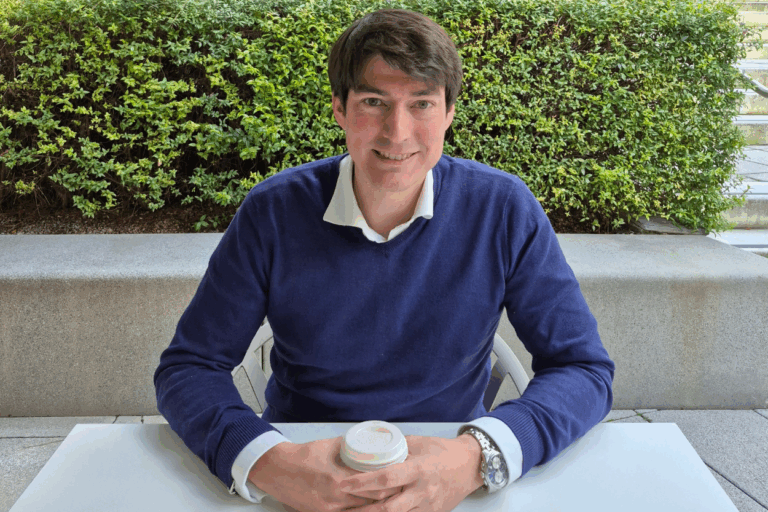
A coffee with… NUMA-POMPILIO, Logistics & Civil Works Manager & Discipline Technical Authority at REPSOL
Numa is an energy industry professional with over 10 years of international experience in the logistics sector. With a degree in Civil Engineering specialised in Transport from the Technical University of Madrid, he has held different positions across all types of operations around the world. He is a highly enthusiastic and dedicated professional, with a strong focus on innovation and talent development as a key value for the industry of the future.
L&A: Numa, tell us what your day-to-day work is like at Repsol and what responsibilities come with leading the Logistics & Civil Works area in an industrial company of this scale.
Numa: Repsol’s Exploration and Production business operates within a matrix organisation structured by disciplines that provide support and services to business units and assets with operated, co-operated and non-operated activities. Within this framework, the Logistics and Civil Works department forms part of the disciplines that provide technical and functional support across all areas of the company.
Day-to-day work is consistently intense, as we support so many operations across the world. The role requires constant flexibility and adaptability in order to respond to every scenario that may arise.
We work on everything from long-term strategies looking five years ahead to mid-term reviews spanning three to six months, which allow us to assess how confidently we can meet the forecasts and agreed targets. Logistics is ultimately a support function that ensures the continuity of operations. A failure in the supply chain can lead to considerable losses for the company.
L&A: The logistics sector is undergoing a period of deep transformation: digitalisation, automation, new operating models… What would you say are currently the main logistics challenges for industrial companies such as Repsol?
Numa: Being able to encourage logistics staff to develop and adapt to new trends in order to provide a more competitive service. One important aspect is the introduction of AI, not as a replacement for jobs, but as a tool to make work more efficient.
All recurring and repetitive tasks should gradually be replaced by AI, allowing people to dedicate their time to identifying opportunities, training and specialising in order to perform their work more effectively.
Another key challenge is being able to offer job opportunities to new professionals in order to attract and retain talent. Logistics profiles are extremely diverse, and companies must be able to bring employment opportunities closer to training centres and universities.
It is also essential to raise awareness among the customer — in this case, internal stakeholders — of the need to have the most accurate information possible and to create the right communication channels in order not to miss opportunities.
Today, opportunities arise daily: from logistics operators offering new services by opening new transport routes, to providing warehousing and consolidation services where previously there was nothing. Being the first to identify and take advantage of these opportunities is fundamental.
L&A: In a context of energy transition and decarbonisation targets, how is industrial logistics transforming to move towards more sustainable operations?
Numa: Faster than we are able to adapt, and slower than we would like. There are new transport technologies across different modes that allow operations to become more efficient. However, the transport sector has a natural inertia that means change is adopted at different speeds depending on the mode, the industry or the country where operations take place. Regulation plays an important role in standardising the use of fuels with a percentage of renewable biodiesel or the use of hydrogen as an alternative fuel source.
On the other hand, logistics operators require significant investment to renew their transport fleets, from maritime and river shipowners to road transport companies. For example, in maritime transport, using a high percentage of biodiesel can reduce engine efficiency and cause issues in certain engine components, such as fuel filters, in vessels whose engines are not prepared for this type of fuel. Renewing these fleets requires time and high costs.
All this means that the energy transition is already here, but it will require more time and effort from all stakeholders involved for it to be complete and satisfactory for society. This is a commitment we must all undertake.
However, as this change will not be immediate, existing technology will also require additional effort to ensure it is used in the most sustainable way possible.
L&A: And looking at trade fairs such as Logistics & Automation, what value do you think these events bring to professionals and industries seeking to update processes, identify trends and accelerate their logistics transformation?
Numa: These types of trade fairs bring together all the transport stakeholders mentioned earlier to share best practices, understand where the sector is heading and stay up to date with trends from transport companies, digital players and industry associations.
It is a way of stepping outside your day-to-day routine — leaving your forest, where you only see trees — and seeing part of the bigger picture. At this fair in particular, there are also forums and companies offering training, showcasing labour market trends in the sector and sharing techniques to develop, attract and retain talent.
Personally, it has also allowed me to connect with digital companies and training and technology consultancies that help us improve our processes. As an operating company, it is always beneficial to maintain contact with all types of businesses.
L&A: And to finish this coffee… what motivates you most about the world of industrial logistics, and what would you like to see evolve in the coming years?
Numa: Logistics is a fascinating, dynamic and constantly evolving sector. It allows professionals to be exposed to a wide range of activities and operations without needing to specialise entirely in one specific industry, as similar rules and processes can be applied across sectors, which provides tremendous versatility.
In our case, the logistics function is combined with civil works related to maintenance and infrastructure usage. By integrating both functions, operations can be adapted to logistics activities in a more efficient way.
This type of integration is, in my view, where logistics should evolve — towards well-integrated logistics embedded in all processes, enabling early identification of logistics needs so that it stops being a problem to solve and becomes a competitive advantage. With robust data models and analytics supported by Artificial Intelligence, we should be able to anticipate demand and respond more effectively and efficiently to industrial needs.
Another necessary evolution lies in talent development, bringing companies into closer contact with universities and training centres in order to align industry needs with educational programmes.


Subscribe our newsletter
MELYT and CONFEBUS join forces to promote female talent in bus transport
· Coinciding with the celebration of 8 March, International Women’s Day. · CONFEBUS is committed to bringing more women into the sector and addressing the
The importance of change management in technological transformations
When walking through the halls of an event as vibrant as Logistics & Automation, it is easy to be seduced by the industry’s ever-increasing brilliance.
Interview with Carlos Moreno: Leading Transport Transformation with SAP Transportation Management
1. Carlos, could you briefly tell us what your role is at Westernacher and how you support your clients in optimising their logistics processes? As
The industry does not have a production problem, it has a synchronisation problem.
Gabriel OcioCommercial Director, Supply Chain SolutionsZucchetti Spain For years, the focus of the industry has been on improving production capacity: more automation, more information and
Share this article