




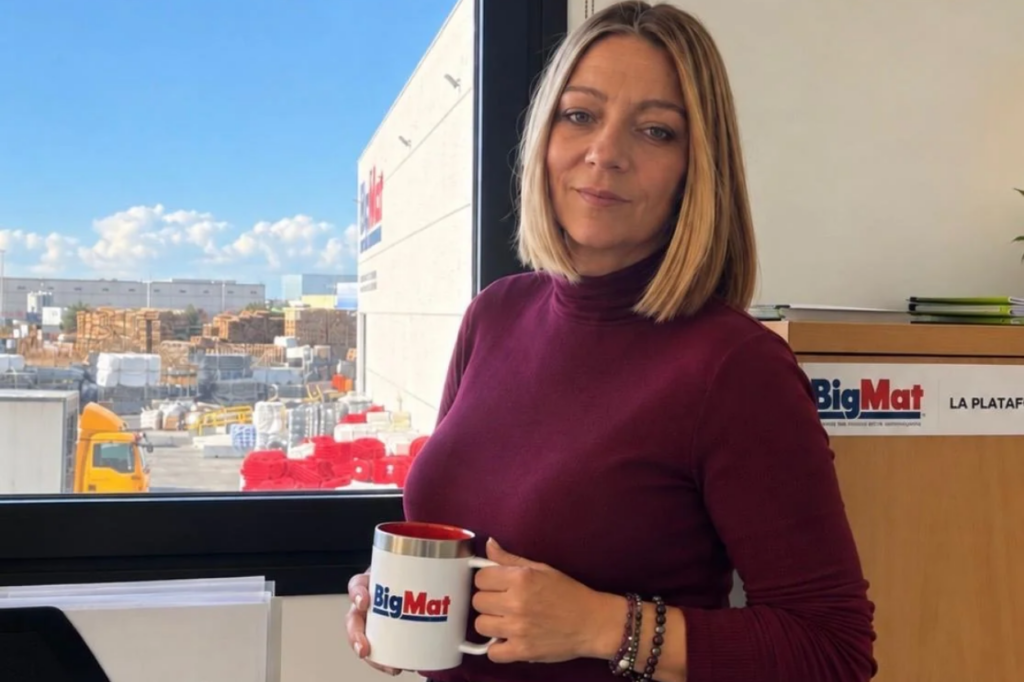
A coffee with Soraya Iglesias, Logistics Centre Manager at BigMat
Soraya Iglesias is the manager of BigMat’s logistics centre. She has over 23 years’ experience in the sector, having worked for Saint-Gobain, Obramat and BAUHAUS. She has led warehouse redesign projects using Kaizen, Lean and 5S methodologies. She believes that logistics is learnt on the shop floor and that teams come first.
L&A: Soraya, you’ve built your career at companies such as Obramat, Bauhaus and now BigMat. How has your view of logistics evolved over the years, and what lessons would you highlight?
Soraya: I’ve worked my way up from the bottom and have never hesitated to roll up my sleeves and join the teams, especially during difficult times – those early mornings when we had to pull together to get the orders sorted. By sharing in that effort, I gradually earned their trust. That experience has shaped my management style: being present, listening and understanding what each decision means for those on the warehouse floor. That’s why, every time I design a process, I ask myself how it’s experienced from the aisle.
I’ve learnt three key lessons. Firstly, the best improvements are those proposed by the people doing the work – hence my fondness for Kaizen, Lean and 5S. Secondly, training others is the best investment you can make. And thirdly, perseverance counts for more than talent: nobody handed me anything on a plate, and I wouldn’t change a single one of those early mornings.
L&A: As the manager of one of BigMat’s logistics centres, what are the main day-to-day challenges you face in ensuring a smooth and efficient supply to the retail outlets?
Soraya: The big challenge is balancing service levels, costs and safety, without losing sight of the team. The shop needs products to be available and delivered on time, and the centre has to achieve this with limited resources.
In practice, this means planning procurement and stock arrivals, maintaining a high-quality stock, managing returns, damaged goods and obsolete stock, and coordinating with logistics, department heads and store management so that everyone is working towards the same goal. Good supply chain management begins long before the lorry arrives: in the flow of information between departments. I worked with clear metrics, such as service levels, unloading and preparation times, errors and cost per operation. But a metric only improves if people understand what is expected of them and feel that their views are being heard. Safety is part of that equation. My approach is to anticipate, make data-driven decisions and provide support. When the team works with clarity and without constant pressure, service improves and costs fall.
L&A: Automation and digitalisation are transforming warehouses. Based on your experience, where do you think there is the greatest scope for improvement in the operations of logistics centres?
Soraya: I see the greatest potential in linking processes, data and people. A lot is invested in technology, but processes are often not standardised and data isn’t used to inform decision-making. Before automating, it’s best to get things in order.
In my experience, logistics is where a large part of the real savings lie, although it doesn’t always appear that way. In a comprehensive warehouse redesign project, applying Kaizen, Lean and 5S, we improved operational efficiency by 25 per cent and reduced downtime by 18 per cent.
What matters is how this is achieved: by training the team, explaining the rationale behind each change and recognising their contribution. Savings achieved at the expense of people do not last; those built with them do. And above all, this helps retain talent, which is one of the most valuable assets of a logistics centre today.
L&A: At events such as Logistics & Automation, solutions and experiences from different sectors are shared. What technologies would you like to see in action, and which discussions would you be sure not to miss in the conference halls?
Soraya: I’m interested in seeing solutions with a proven track record: advanced warehouse management systems (WMS), robotics and assisted picking, machine vision, and data analytics and visualisation tools. Rather than just looking at the machinery, I’d like to ask about the return on investment, the implementation timeframe and how the team was supported through the change.
In the conference rooms, I’d be looking for three key discussions. Firstly, how to manage change and train staff to work with new tools. Secondly, attracting and retaining talent in logistics – a sector that needs to make itself more appealing to young people and women. Thirdly, I’m interested in data applied to day-to-day operations: how to move from simply looking at indicators to using them to anticipate future trends. Events such as Logistics & Automation are valuable because they allow us to learn from other sectors and from those facing the same challenges. Many of the best ideas I’ve put into practice have come from a chance conversation in the corridor or at meetings with industry professionals.
L&A: And to round off our coffee… if you could, with a stroke of a pen, eliminate one of the biggest headaches for any logistics centre manager, which one would you choose?
Soraya: I’d choose uncertainty: that information on demand, orders or incidents arrives late or is incomplete. Much of the daily pressure stems from having to react at the last minute, and that comes at the cost of overtime, urgent deliveries, mistakes and staff burnout. With earlier visibility, we could plan better, distribute workloads more evenly and provide stability for the teams. The latter is particularly important to me, because a team that isn’t constantly under pressure works with greater confidence, makes fewer mistakes and is more likely to want to stay. If I could remove one more thing, it would be the idea that logistics only get noticed when something goes wrong. Behind every order that arrives on time lies planning, expertise and a committed team that deserves recognition. Uncertainty cannot be eliminated entirely, but it can be reduced through reliable data, good communication between departments and staff trained to make decisions. And that is what I dedicate my day-to-day work to.


Subscribe our newsletter
The solution to the distribution centre’s final bottleneck
While robots and autonomous vehicles move through modern warehouses, most distribution centres still rely on people to build mixed pallets by hand. A new generation
The solution to the distribution centre’s final bottleneck
While robots and autonomous vehicles move through modern warehouses, most distribution centres still rely on people to build mixed pallets by hand. A new generation
Parking depots and duotrailers: infrastructure that boosts transport efficiency
Transport efficiency does not depend solely on the vehicle being used, but also on the logistics network that supports it. In a context shaped by
For many warehouses, the challenge is no longer whether to automate, but how to expand existing automation without disrupting daily operations.
For many warehouses, the challenge is no longer whether to automate, but how to expand existing automation without disrupting daily operations. Expanding an automated operation
Share this article