



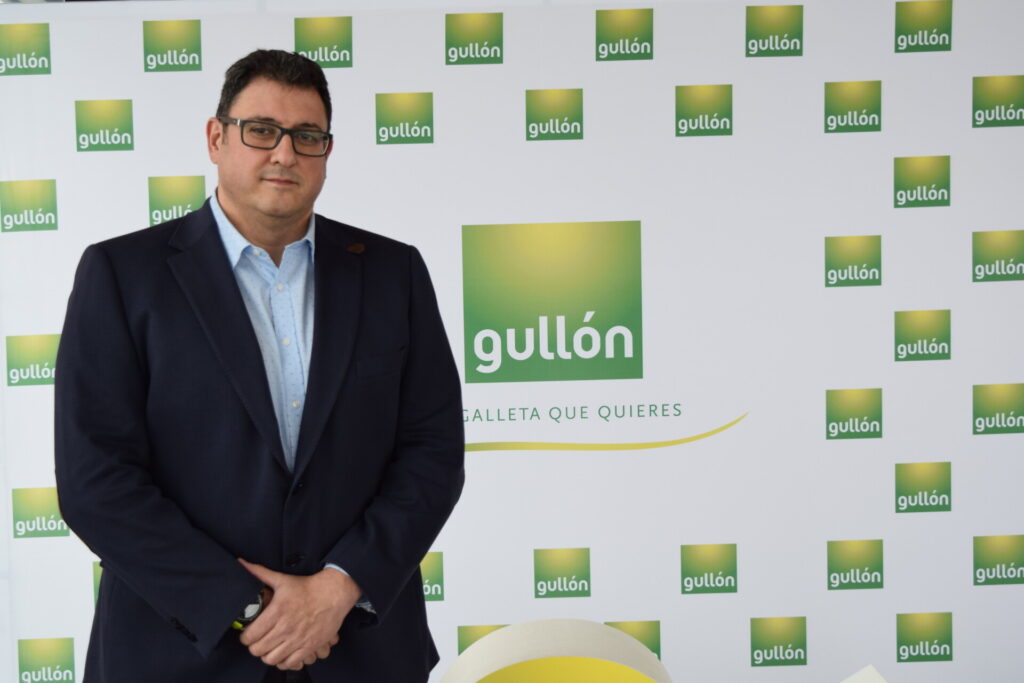
A coffee with Javier Torres, Head of Logistics at Galletas Gullón
L&A: Javier, you’ve been involved in the logistics department at Galletas Gullón for years. How has the company’s supply chain evolved during this time, and what has changed the most?
Javier: The evolution has been enormous, particularly because logistics has moved from being a support function to becoming a strategic element of the business. In fact, Galletas Gullón’s growth, both in terms of volume and markets, has forced us to develop an increasingly efficient, flexible and robust supply chain.
I’d say the biggest change has been the integration of technology. We’ve made progress in automation, digitalisation, planning and traceability, increasingly using data to make decisions and optimise stock levels, warehousing and transport. It’s also been essential to strengthen coordination between production, warehouses, logistics operators, hauliers and customers.
Furthermore, recent years have shown us that the ability to adapt is essential. The pandemic, strains on international supply chains, rising energy and transport costs, and inflation have put our responsiveness to the test. Rather than slowing down, we have used these circumstances to accelerate investment and build a more robust supply chain that is prepared for the future.
L&A: With such high production volumes and a presence in so many markets, what do you consider to be the essential ingredients for logistics to run like clockwork?
Javier: I’d say there are five key elements: planning, technology, coordination, flexibility and a team that’s prepared to anticipate problems.
In a company like Gullón, which operates in over 125 countries, it is essential to have an integrated view of the entire supply chain, from production and warehousing to transport and customer relations. Digitalisation and automation enable us to optimise stock levels, improve traceability and access the information needed to make decisions more quickly.
But technology alone is not enough. We need very close coordination between the different areas of the company and with our suppliers, logistics operators and hauliers. And, above all, the ability to adapt to changes in demand or unforeseen circumstances.
The ultimate goal is very simple to explain, although it is not always easy to achieve: to ensure that the product is available when and where the customer needs it, whilst maintaining high levels of efficiency and quality.
L&A: Why would you recommend attending events such as Logistics & Automation to colleagues in related departments or other professionals in the sector?
Javier: Because in a sector that is evolving so rapidly, it is essential to find out first-hand what solutions are being developed and the direction in which logistics is heading. These events allow us to share experiences, learn about new technologies and compare how other companies are tackling challenges that, in many cases, are common to us all.
For those of us working in logistics, I think it’s particularly interesting because innovation is no longer limited to a specific technology; it affects planning, automation, digitalisation, traceability, stock management and sustainability.
Furthermore, these events help to broaden our perspective. At Gullón, we have found that investing in logistics also means investing in competitiveness, resilience and adaptability. Sharing these kinds of experiences and listening to those of other professionals can help us identify opportunities for improvement and anticipate the changes to come.
Ultimately, logistics is a field undergoing constant transformation, and nobody has all the answers. That is why learning and sharing knowledge with other professionals is so important.
L&A: What is the company’s commitment to sustainability? What changes have you implemented and do you expect to implement in the near future?
Javier: Sustainability forms part of our logistics strategy, based on the understanding that efficiency and sustainability must go hand in hand. We have worked to optimise loads, reduce unnecessary journeys, improve vehicle utilisation and collaborate with operators committed to decarbonisation and more efficient transport solutions.
Digitalisation also plays an important role, as improving planning and having more accurate information allows us to make better use of resources. The aim is to reduce the environmental impact of our operations without compromising on service quality.
Looking ahead, we will continue to make progress in this area through investment in technology, automation and new infrastructure. One of our strategic projects is to further enhance our logistics platform in Aguilar de Campoo, which will feature a new automated, climate-controlled silo for 37,400 pallets – including storage for English-style pallets – and will enable us to centralise and optimise reception, storage and dispatch processes. Combined with our existing infrastructure, this will give us a nominal capacity of 138,000 pallets.
This is a good example of how we intend to continue growing, with logistics that are more efficient, flexible, technologically advanced and responsible.
L&A: Finally, what advice would you give today to the ‘Javier’ who started out in logistics all those years ago?
Javier: I’d tell him never to stop learning and, above all, not to be afraid of change. Logistics has evolved enormously and will continue to do so, so it’s important to keep an open mind and understand that there’s always a better way of doing things.
I’d also tell him to look at logistics from a broader perspective. It’s not just about moving or storing goods; behind it all lies planning, technology, people, customers, suppliers and a business strategy. When you grasp that big picture, you truly understand the value that logistics can bring to a company.
And finally, I’d tell them to trust their teams and embrace collaboration. The most complex situations of recent years have shown us that adaptability and coordination are essential for overcoming any difficulty.
If there’s one thing I’ve learnt from Gullón’s evolution, it’s that investing in logistics is investing in the company’s future: in competitiveness, innovation, sustainability and the ability to continue growing.


Subscribe our newsletter
A coffee with Javier Torres, Head of Logistics at Galletas Gullón
L&A: Javier, you’ve been involved in the logistics department at Galletas Gullón for years. How has the company’s supply chain evolved during this time, and
September: taking a forward-looking fresh look at the supply chain
September always feels like something of a fresh start. We come back from our holidays, pick up our projects again, review our objectives and begin
Logistics and Automation will offer a diverse overview of warehouse automation technologies
Logistics & Automation will showcase a diverse range of warehouse automation technologies. In this environment, a trusted partner with proven integration and service capabilities is
The UNO National Awards for Logistics Leaders are being held for the seventh time at Logistics & Automation
The awards ceremony will take place on 11 November at IFEMA Madrid, coinciding with the first day of the trade fair. This year’s edition introduces
Share this article